Showing posts with label bush. Show all posts

Monday, December 12, 2011

In the Bush: Chapter 3: The 100 Rand


I must really apologize on how slowly I have been with my blog updates.  I figure that in order to make up for it, it's best that I start sharing with you my actual wildlife viewing experience.  Needless to say, I think it's best that I start with the Big 5 which were the famous sightings at the game reserves that I was at.

The Big 5

I found out much later, but apparently the Big 5 used to be the Big 5 most dangerous animals to be hunted (and also the most popular).  In these modern days, they are still referred to as the Big 5 for viewing only.

So you might now wonder, which 5 are they?  Interestingly enough (and again, the connection was NOT AT ALL obvious to me at first) I was introduced to them on my very first day to South Africa.

And yes, there they are, on each of the 5 South African notes, the Big 5 (left to right): Rhino, Elephant, Lion, Water Buffalo, and the Leopard.

I have decided to start the series of Big 5 animal sightings with the most popular bank note (it's like our CAD $20 at the ATM) here in South Africa - the 100 Rand or the Water buffalo.


Big 5 series 1: Water Buffalo


In fact, the water buffalo was one of my first sightings at Kirkman's Camp on our first game drive.  After seeing some impalas, Ralph, our ranger at KC,  drove quickly into a marshy area where there were two water buffalos hanging out (eating and relieving themselves).

 
We were told that they were both bulls (males) and they were likely kicked out of the breeding herds because the herd they were likely older, so they stay close to but not inside the herds. Some older bulls cease to rejoin the herd, as they can no longer compete with the younger, and so they hang out in their own groups.


The next day on another drive, we saw another set of water buffalos (this was the day when we saw all of the Big 5 over the morning and the afternoon drive, and it was my 2nd day only! Absolutely amazing but more on that later!)  This time, they continued to eat and relieve themselves...


Check out the relieving...# 1
We then continued to encounter them throughout my stay. I must say they were very often spotted at Kirkmans and at Ngala.  At Phinda, the frequency of sighting was slightly less, but we did encounter a herd once at night (where we spotted a baby water buffalo very quickly).  But unfortunately, because they were day-time animals, we couldn't keep the light on them for too long. It was one of my first evening drives at Phinda Forest, so Wayne, my ranger, said we'll go look for them another day - on days when my request was, let's go find some baba whatevers!

Here's one that has been rolling in the mud with oxpecker birds on it

@ Phinda Forest, and we saw one cross the road in front of us, and the rest of the herd on the right, just outside the picture

The herd hanging out under the trees to get some shade and cool down

And there's the baby that I was looking for!

You can see that the baby (or the calve) stick very close to its mother and only has little stubs as horns! They generally stay in the middle of the herd for safety


These two were busy drinking

A picture of the baby again


This one was not as little but was definitely another baby water buffalo

aww

the baby was feeding


And it was so small that it disappeared into the tall grass =P
 We also ran into another herd of water buffalos while at Phinda Mountain.  The landscape is completely different and there was a big herd.

This one decided to pose for my picture ;)
Supplementary details


Apparently due to their sizes, these buffalos have few predators and they are able to defend themselves against the lions (and sometimes kill a lion - youtube - battle at kruger)  Apparently sometimes there are prides of lions who have learned how to kill buffalos successfully and they have a method of ambushing them.
According to wiki, the cheetah, leopard and spotted hyena are a threat only to newborn calves, though spotted hyenas have been recorded to kill full grown bulls on occasion. (yes, I will also have features of these animals ;) - as I've mentioned, I've seen quite a bit


Afterthought


I must say though, at certain part of my two week trip, I did get a bit bored of seeing these water buffalos.  I mean when I see them all they do is eat (chew chew chew, nom nom nom) and relieve themselves (no.1 & no. 2).  My excitement was revived when we saw the big herd with a few little ones.  They are quite cute.  Another excitement revival time was when I started teaching people what water buffalos are called in chinese (because there are asian ones for farming called "water cows" - 水牛 )However, I have learned (more so from watching other animals than these ones) that you have to be patient because they are wild animals, you never know what they will do next... and that's what so fascinating about this experience...


To be continued... don't miss the next part of the series...can you guess which one it would be?


Thursday, November 17, 2011

In the Bush: Table of Contents

Yes! After clearing out some of the backlogs of blogposts,  I can finally begin to write about my bush experience.  (There was also a French test between coming back from the Bush last Saturday until today which kept me a bit pre-occupied and held off the symptoms of "bush withdrawal" for a bit).

As I've been saying to all the South Africans that I've met on the trip and now back in Joburg, "Your Country is beautiful!". If you were following my early posts, you would've realized that I have already fallen in love with Cape Town.  But I think now that I've experienced the magical bush, I have to say, "Sorry, Cape Town, but I've fallen head over heels in love with the South African bush, in particular- Phinda (a game reserve) instead".  (I was quite depressed to leave after staying a week at Phinda Forest lodge, i've never felt that way about any other places in the world.. that means something).


The bush: definition

If you've missed the post on the bush preview, you would've missed the definition of a "bush" and I'm sure I must've confused you so far.  The first time when I heard the term used was when a colleague of mine, Peter the Aussie VolCon, mentioned that he was going to go play "Bush Golf".  The image that immediately came up in my head has a person golfing around a giant bush (plant shrub)/ a golf course characterized by bushes instead of trees.  And I was so confused and asked "What do you mean? How do you play golf around a bush??".  Then Peter explained that "Bush"is the term that South Africans use instead of "country side", kinda like our woodlands/forest/Algonquin Park equivalent. Ahh, now i get it.

There are quite a bit of terms that I still need to clarify with you, but let's just get on with the good stuff as I think you're dying to find out more about why I had the time of my life and how.  So without further ado, let me share some facts/background with you:

Why I was where I was: 


This magical bush adventure was part of a high-end tourism project.  I must say, it was very difficult to concentrate on work in the "resort" environment, but I constantly reminded myself that it was important to focus and deliver.  I'm also extremely thankful for our hosts who have designed a schedule that enabled maximum bush enjoyment and work (minimized sleep, but sleep is overrated anyways - I can sleep when I'm back in joburg, I can sleep when I'm back in Canada).  So truly appreciative of the opportunity to maximize my experience.

(P.S. it is also quite important for me to deliver, as we really want this program to achieve success.  If that is the case, there might be an opp for me to return in a year to do evaluation and recommend expansion! *fingers crossed*)


More definitions


"game reserve" (according to wiki) is an area of land set aside for maintenance of wildlife for tourism and/or hunting purposes. (I believe the hunting part is now dated, hunting areas usually are separate to the game reserves and have a different names, with animals that are bred for hunting/required to be culled).

"game drives" are literally a drive to go see the games (wildlife).  It's known to the rest of the world as a "safari" I think. And the definition of a Safari (according to wiki) is traditionally a big-game hunt but today the term often refers to a trip taken not for the purposes of hunting, but to observe and photograph animals.  The word has its origin in Swahili (which is a bit random to be used in Africa).


Now the fun facts (or indicators):


Work-related:
No. of  communities visited: 6
No. of meetings held: 9 (including one with the mayor and councillor!)
No. of entrepreneurs met: ~330


Personal:
No. of reserves visited: 3
No. of resorts stayed: 4 (see post on Lodges  - stay tuned)
No. of nights stayed: 12 (in total)
No. of game drives: 19 (4 in Sabi, 4 in Ngala, 11 in Phinda)
No. of animals sighted: lots!
No. of pictures taken: lots!! (I think video and photos combined at around 12Gb for the two weeks) and hence the delay in post writing, since I don't want to spoil the content by publishing without pictures.


Locations :

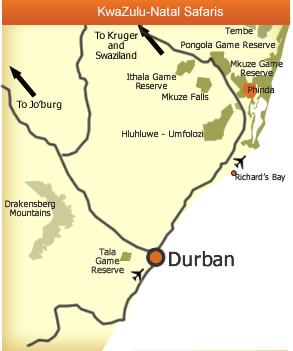
As mentioned above, we were at 3 locations: the Sabi-sands game reserve, Ngala game reserve and Phinda game reserve.  The first two are in the Mpumalanga  region while the last was in the KZN (Kwa-zu Natal) province.  You can see a map here for the first two.

Both Ngala and Sabi-sands game reserve share an unfenced border with Kruger National park.  Kruger is one of the largest game reserves in South Africa and covers around 20000 square km of land.  By sharing an unfenced border with kruger, it means that you never know which animals you will see in Ngala and Sabi-sands.  The area is big enough such that it's less close-system like, giving more room for the animals to run around in.  Both Ngala and Sabi-sands are private which means the area is exclusively accessible to guests at the lodges.

However Phinda is a bit different.  Phinda covers an area around 23 000 hectares and is a closed system (well with some fences that don't really work so some small animals do go into the neighbouring reserves - but  more on that later).   The feature of Phinda is that it contains 7 distinct eco systems " - a magnificent tapestry of woodland, grassland, wetland and forest, interspersed with mountain ranges, rivercourses, marshes and pans." according to their website.


The purpose of this post:


.. is not only introductory but I'm hoping that it'll serve as a bit of a table of content and a link page.  I'm going to try to vary up the content a bit, but there will definitely be animal features - the Big 5, the turtle trip, the "boks" as i like to call them, birds, even trees and nature...

In the Bush: Preview
In the Bush: Table of Contents (you're reading it right now!)
Chapter 1:  Where I stayed - high end lodges
Chapter 2: The daily routine & game drives 
....to be continued

Friday, November 4, 2011

In the Bush: Preview

I'm back in civilization for a short 12 hours (tonight) and I'm off again into the "bush" again tomorrow.

South Africans refer to their countryside as the "bush".  I had the time of my life experiencing the wild life up close last week in Sabi-Sands Game Reserve and at Ngala Game Reserve (both sharing an unfenced border with the Kruger National Park).

The experience is unlike anything that I have had before. I can't wait to share it with you.  However, the internet connection is extremely limited in the bush (I was disconnected from the world for about 2 days last week in Ngala).  It's kinda nice, but it means that it's going to take awhile before I'll catch up on my posts (and sharing some of my South African Wildlife Experience via pictures)~

I'm off to Phinda game reserve tomorrow for the week!  The posts will come in about a week ;)

Stay tuned~~